
Dubrovnik: Summer School of Medical Ethics of the Croatian Catholic Medical Society (HKLD).
Dubrovnik, August 9 – 16, 2025.
The Summer School of Medical Ethics of the Croatian Catholic Medical Society (HKLD) was held in Dubrovnik From August 9 to 16, 2025. The Society, founded in 1991, currently gathers over 1,300 physicians, dentists, pharmacists, and other highly educated healthcare professionals with the aim of promoting Christian ethical principles in medical practice and the education of healthcare workers. However, it is only this year that the conditions were ripe for organizing such a school, which has been planned for several years.
The organization of such an interdisciplinary school lasting a week was a highly demanding project. On one hand, it required gathering a group of respected and representative healthcare professionals who will speak about various ethical topics and dilemmas that healthcare workers encounter in medicine. On the other hand, it required bringing together young students and healthcare professionals from different fields willing to dedicate a week of their summer vacation to this content. The school took place in the premises of the ancient Jesuit College in Dubrovnik (Collegium Ragusinum), which was attended by numerous notable Dubrovnik figures, including Ruđer Bošković (Roger Joseph Boscovich SJ), a physicist, astronomer, mathematician, philosopher, diplomat, and theologian. The program was designed for students and young physicians, dentists, pharmacists, and other healthcare professionals aged 18 to 35.
Despite initial skepticism, the first Summer School of Ethics was successful in gathering eleven speakers and mentors, including seven medical doctors (specialists in psychiatry, gynecology and obstetrics, neurology, pediatrics, and infectious diseases), two masters of nursing, one master of pharmacy, and one philosopher/theologian.
On the first day of the Summer School, Prof. Marta Čivljak and Fr. Domagoj Augustin Polanščak discussed the fundamental principles of medical and Christian ethics. On the second day, Ivan Zmijanović, MD presented moral dilemmas in gynecology and obstetrics from the perspective of a gynecologist and obstetrician, while in the afternoon session, Prof. Marta Čivljak opened a discussion on post-abortion syndrome, which is rarely addressed but impacts not only those involved in performing abortions but also everyone who later deals with its consequences.
The third day focused on the issue of conscience clauses in medicine (Antonija Vukšić, MD), followed by a discussion on ethical issues in reproductive medicine from the perspectives of the married couple Lovro and Nikolina Mlakar (physician and nurse) who shared their personal testimony on the importance of advocating for every human life. The fourth day dealt with ethical questions related to vaccination (Prof. Rok Čivljak) which can be seen as an intervention between an act of love and a call of conscience, as well as various forms of addiction (Marija Bošković, MD), with an emphasis on addiction among healthcare professionals. The fifth day was dedicated to nurses and technicians (Marin Čargo, RN) and pharmacists (Andrea Koščec, M.Pharm.) as close collaborators of doctors and the ethical challenges associated with their professions. On the last day of the Summer School, Marija Radonić, MD led a workshop on a holistic approach to the sick child and ethical challenges in pediatrics, while Marin Čargo and Prof. Marta Čivljak conducted a workshop on ethical issues related to the application of artificial intelligence in medicine.
This year’s Summer School of Ethics gathered young medical students from Rijeka and Zagreb, as well as young physicians from Čakovec, Varaždin, Zagreb, Rijeka, and Dubrovnik. However, the interdisciplinary approach to examining ethical issues in medicine was also enriched by the participation of nurses/technicians, along with two economists and one graduated philosopher and pedagogue, which broadened the scope of discussions on various ethical questions.
The Summer School included not only lectures from esteemed experts in different areas of medicine but also meticulous and high-quality discussions, group work, and opportunities for individual conversations with speakers and mentors, which participants described as giving special value to this Summer School. Equally important was the daily spiritual and cultural life, with morning prayers in the College chapel, mass celebrations in Dubrovnik’s churches, visits to the Franciscan Monastery of the Order of the Friars Minor (led by Fr. Jozo Sopta and Fr. Tomislav Šanko), visits to the Monastery of St. Dominic (with guided tours by Prior Fr. Saša Stjepan Bukvić OP), as well as the Church of St. Blaise (Msgr. Ivica Pervan) and the Dubrovnik Cathedral (Rev. Marin Lučić). The School also included participation from Dominican Fr. Domagoj Augustin Polanščak OP as a speaker and mentor, and upon his recommendation, a young Dominican novice Fr. Timotej Faustin Otto (originally from Slovenia), currently in novitiate at the Dominican monastery in Dubrovnik and preparing for the study of theology and philosophy in France.
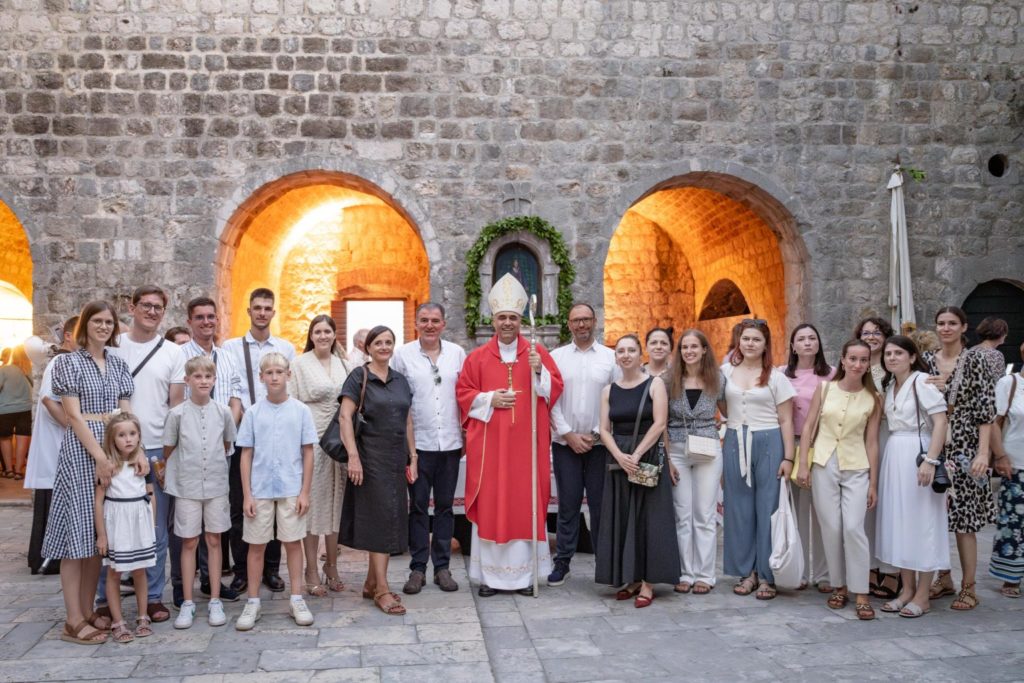
On two occasions, participants met with the patron and host of this year’s Summer School – the Bishop of Dubrovnik, Msgr. Roko Glasnović – during the procession and reopening of the Chapel of St. Lawrence at Fort Lovrijenac (St. Lawrence Fortress) on the feast day of St. Lawrence, as well as during Bishop Glasnović’s visit to the Jesuit College where this year’s Summer School was held. On that occasion, speakers and participants had the opportunity to meet the bishop and exchange their experiences and reflections on ethical questions and the engagement of lay believers in the Church.
After a week of shared work, fellowship, prayer, and rich coexistence, both participants and speakers enthusiastically concluded that participating in the first Summer School of Medical Ethics of HKLD was an unforgettable experience. Through group work, it was felt that the ethical dimension indeed gives full meaning to our professions. Discussions revealed that every clinical situation requires much more than technical knowledge; it demands wisdom, compassion, and courage.
Among the conclusions of the Summer School, it was emphasized that the good we do as healthcare professionals is never abstract – it is directed towards the person in front of us as a patient. Sometimes it may seem that the solutions are contradictory or that there is no “ideal” answer to all clinical questions. However, it is precisely then that ethical reflection comes into play: how to do the greatest possible good with the least possible harm, respecting the freedom and dignity of every person involved in that decision. Medicine is never just a science; it is a call to be guardians of life, from its beginning to its natural end, and to consider what will bring the greatest benefit, comfort, and meaning in every decision. If we persist in that, then ethics will cease to be just a topic for schools or lectures and will become a daily way of our work and life.
The Summer School of Ethics of the Croatian Catholic Medical Society demonstrated how precious collective reflection through teamwork and interdisciplinary dialogue can be. None of us has answers to all questions, but each person (physician, pharmacist, nurse/technician, caregiver, priest) can contribute their experience and perspective towards finding those answers. It is in that exchange that wisdom is born. Only love and knowledge grow the more they are shared, and this School encompassed both.
Rok Čivljak, Ivan Zmijanović
Photos: Andrea Koščec, Nevenka Nedić, and Željko Šoletić