
Anne Lastman
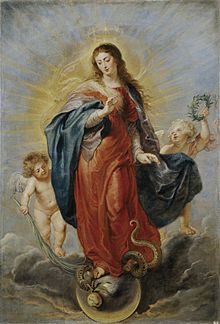
December 8th Marks the feast day of The Immaculate Conception. A feast day which marks the great honour and privilege given to our blessed mother, who by a special grace of God was born free from Original Sin. through the future work of redemption by her son Jesus and the merits from this work, her purity and nobility are lauded by all generations. The blessed Virgin Mary throughout her life, beginning from her conception, had walked a path of perfection. The breath and whisper of sin had not touched her.
Whilst our protestant brethren oppose the understanding of the Catholic church regarding Mary and strongly assert that Mary was conceived in the normal way of conception and she too would need redemption like all humanity. Perhaps a response to this understanding emerges from literal reading of the scripture without context and “type” in Old Testament.
The Words “My spirit rejoices in God my saviour” (Lk 1:47) is understood by non-Catholic as meaning that she herself admitted needing salvation, so she was a sinner. However, we find its type in Issaiah :61:10. “My soul rejoices in my God. For He has clothed me with garments of salvation and arrayed me in a robe of his righteousness that has covered her with his mantle.” A further example and reference in Old Testament “ what joy is mine! Now the other women will celebrate with me” (Gen. 30:13) “All generations will call me blessed”
There is a strong parallelism in ascribing praise.
My soul, mirrors… spirit
Proclaims the greatness of the Lord… .. has found gladness in the Lord.
Of the Lord “… …God my saviour.
In the Magnificat there is allusion to 1 Sam 2:1-10 which complements Hannah’s Magnificat of rejoicing . Of importance is the response to Hannah’s sorrow at her barrenness, but she continues her praise of God and this canticle of Hannah is mirrored by Mary who praises God because He also has chosen her to bear His Son. The promised one. In both instances conception occurs by God’s intervention. In Mary, beginning with her reflection of the ancient Magnificat and her own same response of trust and praise brings before the eyes of the world her state and condition of purity. She reverses Hannah’s barrenness ( in those times considered a curse) with her own fruitfulness and in both instances leading to the birth of a son, though not in normal way of procreation One in the normal way by conception between husband and wife but with divine help in repairing her barren ness (Hannah) and Mary’s conception by divine election.
Mary, daughter of Israel, Virgin of Nazareth, the breath of the spirit of God. Who bore the Lord without being consumed, the place of the Rock which God showed to Moses. Mary the innocent child of Nazareth, pure, whose purity filled the enemy with terror, because he knew that this “woman” the new Eve would not be seduced by his wiles and would bring forth, the Holy One, The Redeemer. .
How can it be that Mary was born without original sin? And Catholic response is by the way of redemption prior to the work of redemption for all creatures. Before her conception the Lord Redeemed her. He put his seal on her so that the enemy could never get near her. The Lord preempted her redemption. I would think that using non biblical thought and language and by way of an example we could say that it’s like the trialing of new drug , perfecting it before putting it on market. Over time and trials and understanding of possible benefits and effects, eventually the drug’s efficacy is known. Over time and generations God worked with a chosen people and slowly refined them, (through suffering) and eventually a pure new “fruit tree was planted” A tree which the New Eve looked at and rejoiced in its beauty. .
Mary was “created redeemed” in God’s heart long before she was conceived in the physical.. She belonged to no one else, ever. Her anima, perfection, her Lord, “The gardener” protected her from ever being under the serpent’s power.
The Immaculate Conception of the blessed virgin Mary was defined and proclaimed by Pope Pius IX on December 8th, 1854, with the accompanying words
“The most blessed Virgin Mary from the first moment of her conception, by a singular grace and privilege of almighty God and by virtue of the merits of Jesus Christ, Saviour of the human race preserved immune from all stain of original sin”. (Apostolic Constitution, Ineffabilis Deus.)
The Immaculate Conception has been a constant teaching of the Church, which affirmed her absolutely purity and sinlessness. She grew in a way we might call “normal” but not in a way of inclination to sin. As she grew full grace a body and place so gracefilled “Kecharitomene” (Angel’s words, “full of grace”) that a divine child could take up residence there. She carried within her human pure, untainted body, (as was Eve before sin) divinity.
The church furthers assert that immediately after the fall of Adam, God cursed the serpent and said, “I will put enmity between you and the woman and between your seed and her seed: He shall bruise your head (Gen 3:15).These words spoken to serpent are important because they announce that the serpent will have seed (fruit of sin) and that enmity will forever exist between the two “seeds.” That is seed of the woman and seed of the serpent (sinful)and further interesting is the fact that it was a “woman’s seed” who would demolish the kingdom of sin. This further explains that the seed of the woman, the divine seed, Jesus and his followers, would be victorious over the serpent’s seed, and his followers children of darkness. The outcome was assured, the seed of the woman would conquer, though with some suffering.
Mary’s immaculate conception could not be otherwise because Eve, before sin, was immaculately conceived. She was created from a part of Adam who still had not sinned, so it would seem inconceivable to believe that the woman of Mercy (new Eve) would herself be conceived with the mark of the serpent. It would be an unequal playing field. Eve born sinless fell for the lies and seduction by the serpent. Mary also conceived immaculately would be called upon to “crush the head of the serpent” not with weapons, but her weapon was purity which was lost to the first Eve by her acceptance of the lie, choice, pride, and most of all doubt. Doubt God’s word.
Mary’s call was to remain free from fear, accept obedience, choice, accept her pregnancy at a time when this would have meant shame and even stoning for her, and above all the belief that God is faithful. He will guard her life. Following the Law of her people, after having given birth to a male child she was duty bound to present herself to the temple for purification, (unclean for 7 days) however as a sinless one she had no need for such purification but like her son Jesus would do when he willingly accepted Baptism though he was “in all ways like us but sin” (Heb 4:15). Mother and Son underwent purification on behalf of all, because they were without sin and sin could not overwhelm them.
God created a beautiful Son Jesus and he also created a beautiful daughter in Mary. Same but different. He also created in Mary, at the incarnation, a pure spouse for the Holy Spirit, The Virgin of Nazareth, who could not be declared anything other than the ‘Immaculate Conception’ Her purity and dignity never compromised.
The splendor of an entirely unique holiness’ by which Mary is enriched from the first instant of her conception’ comes wholly from Christ: she is “redeemed in a more exalted fashion, by reason of the merits of her son’ The Father blessed Mary more than any other created person ‘in Christ with every spiritual blessing in the heavenly places’ and chose her ‘in Christ before the foundation of the world, to be holy and blameless before Him in love.” (CCC #492;CF#493).
The infallible pronouncement by the Holy Father Pope Pius IX was ratified by The Blessed Virgin herself when she appeared to Bernadette Soubirous of Lourdes that she was The Immaculate Conception.”