Cardinal Prospero Lambertini (Pope Benedict XIV)
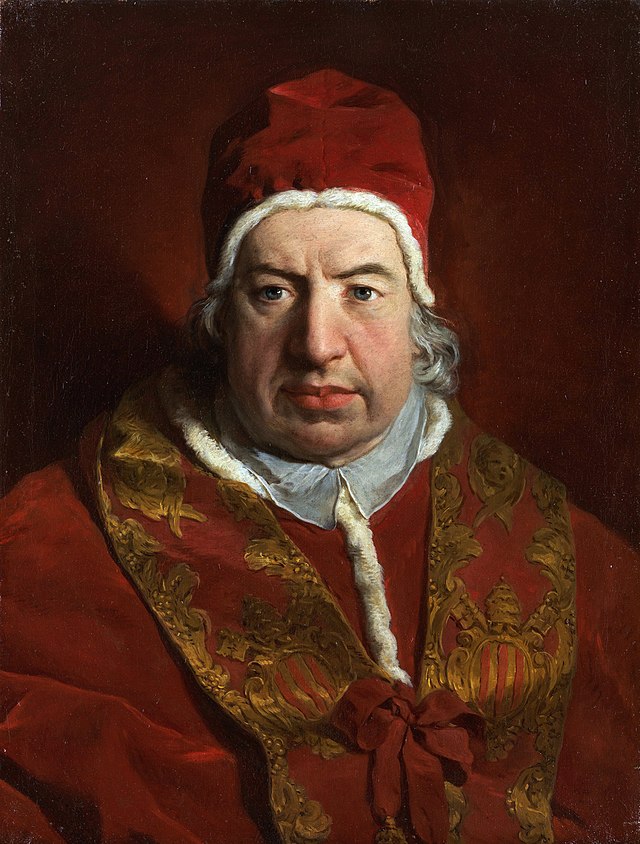
The Church has asked Lourdes since 1908 – for the fiftieth anniversary of the apparitions – that we refer to Lourdes according to Lambertini’s criteria, which we have been doing ever since. You know that in order to beatify and then canonize a servant of God, already recognized as venerable for his exemplary and evangelical life, there must be a miracle – in general a miracle of healing – which takes place after his or her death, recognized by the beneficiary as being due to the intercession of the person who is to be beatified.
Lambertini’s criteria are very logical and still hold true today. You’ll see: these are really very restrictive conditions.
The 1st criterion is that the disease is serious, with an unfavorable prognosis. We’re not going to cry miracles for a pimple that will disappear on the nose!
Secondly, the disease must be known, it must be listed by medicine: we are not starting with vagueness.
Thirdly, this disease must be organic, lesional, that is to say that there must be objective, biological and radiological criteria, everything that currently exists in medicine; which means that even today we will not recognize cures of pathologies without precise objective criteria such as psychic, psychiatric, functional, nervous diseases, etc. This does not mean that we cannot be cured of these diseases, but in the Church’s criteria, it will not be recognized as a miracle in the current state of affairs.
Fourth, there must be no treatment that interferes with healing. There, you see that it is not easy when any disease is treated. This is an important work of medical discernment today.
The 5th criterion is very important, which is the moment of healing itself: the healing must be sudden, sudden, instantaneous, one could say: immediate, without convalescence. This is never seen in medicine. This is a fundamental differential criterion.
After recovery, there are still two criteria: it must not simply be a regression of symptoms but a return of all vital functions, and finally, it must not simply be a remission but a cure, which means something lasting and definitive.
These are therefore exclusion criteria and, in the end, it is not surprising that out of the 7000 healings declared in 150 years to the Medical Office, only 66 have been proclaimed miraculous by the Church. Moreover, no Catholic is obliged to believe in the miracles of Lourdes, (I say “of Lourdes” and not in the miracles of the Gospel…).